Tuesday, July 11, 2006

The Day We Lost Our Masjid


The Day We Lost Our Masjid

Muhammad Alshareef

Do you know the last public place where the Messenger of Allah sal Allaahu alayhi wa sallam was seen? He was seen in the Masjid. About 3 days before he passed away, Abu Bakr radi Allahu anhu was leading the prayer and the Masjid was full with an ummah of men and women prepared to illuminate the world with their jihaad and da’wah. The Prophet’s house opened up to the Masjid; there was a curtain separating his room and the prayer hall. He opened the curtain, saw the congregation, and saw his khalifah, Abu Bakr radi Allahu anhu, leading the prayer. The Prophet sal Allaahu alayhi wa sallam smiled like the moon. The companions saw him while they were in prayer, and from their happiness, almost lost control of the prayer. The Prophet sal Allaahu alayhi wa sallam then drew his curtain, and three days later returned to his Lord subhaanahu wa ta ‘aala.

During the life of the Prophet sal Allaahu alayhi wa sallam, there was a woman who used to sweep the Masjid with her hands, picking up the dirt and disposing of it. In the sight of the community her status was not that high, but in the sight of Allah and her Messenger sal Allaahu alayhi wa sallam, she held a different rank. She passed away one night and the Companions, not wanting to disturb the Prophet sal Allaahu alayhi wa sallam, washed and buried her without informing him. The next day, the Prophet sal Allaahu alayhi wa sallam recognized her absence and inquired about her. They told him about her demise and how they had not wanted to disturb him. The Prophet sal Allaahu alayhi wa sallam was not happy at the action they took. He went to her grave and prayed for her there.

What is a masjid? Many have misunderstood the role that the masjid plays in the development of the community. In some countries, it is a place where the tribal Imam is buried and worshipped. In other countries, it is a place that only prayers may be performed therein; absolutely nothing else will be tolerated. And in yet other countries, not even prayers are performed in it, so-much-so the country may finally decide to convert it into a museum or a church.

Dear brothers and sisters in Islam and to my dearest friends, I would like to introduce you to our friend, the masjid:

In the literal term, masjid means a place of prostration. However, in the technical sense, a masjid is any clean place on earth, as the Messenger of Allah sal Allaahu alayhi wa sallam said:
“The earth was made for me a Masjid [i.e. a place to pray], pure” (Bukhari).
However, a specific place was attributed to the word masjid (the place where the 5 daily prayers are held). This was done in order to distinguish the masjid from the musallah (the place where Eid prayers are held and so forth, so that the rules of the masjid do not apply to it).
Masjid is a word derived from sujood, or prostration. The masjid, or place of prostration, was named such due the honorable position the sujood holds in salah. Thus, it was not called marka’ derived from ruku’.
The first house of Allah ever built on earth was the Ka’bah. Allah subhaanahu wa ta ‘aala says:
Verily, the first House [of worship] appointed for mankind was that at Bakkah [Makkah], full of blessing, and a guidance for Al-Aalameen (A’le-Imran 3/96).
And Allah subhaanahu wa ta ‘aala commanded us to honor and enliven the masjid with His remembrance:
In houses [masajid], which Allah has ordered to be raised, in them His name is glorified in the mornings, and in the evenings (An-Noor 24/36).
Ibn Abbaas, Mujahid, and Al-Hasan commented: “The ‘houses’ are those masajid that were dedicated to the worship of Allah. And verily, the masajid light up the earth for the inhabitants of the heavens, just as stars light up the heavens for the inhabitants of the earth.”
Everyone wants to build a retirement home to be proud of, so listen to this offer. The Messenger of Allah sal Allaahu alayhi wa sallam said:
“Whoever builds a masjid, seeking the pleasure of Allah, Allah shall build a house for him in Paradise” (Bukhari).
He sal Allaahu alayhi wa sallam also said:
“The most beloved places to Allah on earth are the masajid, and the most hated places to Allah on earth are the markets” (Muslim).
The masjid has played a variety of roles in our history. Here is a short tour of some of the roles that the masjid has played:
Children: The masjid was a place where the children would accompany their parents and grow up under the shade of its walls. Abu Qataadah narrated:
“The Messenger of Allah sal Allaahu alayhi wa sallam used to pray and carry Umamah, the daughter of Zaynab. When he would fall into prostration, he would rest her aside. And when he stood up again, he would again pick her up” (Bukhari).
Education: The masjid was the nucleus of education. Throughout history, the masjid was the university that graduated scholars and imams. To name only a few, we have Masjid of Al-Azhar, Masjid Al-Umawee in Syria, and Masjid Az-Zaytoonah in Tunis.
The Prophet sal Allaahu alayhi wa sallam said:
“No gathering gathers in a house from the houses of Allah, reciting the book of Allah and teaching it to one another, except that serenity befalls them, mercy envelops them, the angels surround them and Allah mentions them to [the inhabitants of the heavens]” (Muslim).
Organization: The masjid is where hundreds of Muslims come; all in straight rows; all following the lead of Allahu Akbar; all beginning when the imam begins; all ending when the imam ends.
Shelter for the weak and traveling: In Masjid An-Nabawi, we know that there was a platform, known as the Suffah. The poor and the strangers would find shelter there, and the Messenger of Allah sal Allaahu alayhi wa sallam would grant them shares of the collected charity.
Socializing: The masjid is where the Muslims would meet one another. When someone missed a prayer, he was inquired about and followed up on. Relationships were reared, brotherhood was built.
Think tank: When important issues came up, the Prophet sal Allaahu alayhi wa sallam would gather the Companions in the masjid and consult them on the matter.
Charity: The charity would be collected and distributed from the masjid. It was in the masjid that the Prophet sal Allaahu alayhi wa sallam said:
“Give, if only with a half a date.”
Jihaad: It was from the masjid that battalions were organized and set off for jihaad. During the crusades, many masajid became the podium for inciting the feelings of the Muslims to fight off the transgression.
Serenity: Whenever the Prophet sal Allaahu alayhi wa sallam felt sad he would go and pray. And he sal Allaahu alayhi wa sallam would say to Bilal, “Relax us with [the prayer] O Bilal.”

PART II: The Rights of the MasjidThe masjid is the house of Allah subhaanahu wa ta ‘aala, and it has rights like anything else. Amongst these rights are the following:
First: When someone enters the masjid, they should pray 2 raka’ before sitting down. The Prophet sal Allaahu alayhi wa sallam said:
“If any of you enters the masjid, let him not sit down until he prays 2 raka’.”
Second: No business should take place in the masjid. The Messenger of Allah sal Allaahu alayhi wa sallam said:
“Whoever sells in the masjid, say to them, ‘May Allah not grant success in your sale.’”
Third: The masjid must be kept clean and fresh smelling. The Prophet sal Allaahu alayhi wa sallam said:
“Whoever eats from this tree [i.e. garlic] should not attend our place of prayer.”
Fourth: Advice should be given to fellow Muslims. When the Prophet sal Allaahu alayhi wa sallam would see someone not praying correctly he would advise them to repeat their prayer and teach them how to pray.
Fifth: Allah subhaanahu wa ta ‘aala should be remembered much during one’s stay in the masjid. As Allah subhaanahu wa ta ‘aala says:
O ye who believe, remember Allah with much remembrance. (Al-Ahzab 33/42).
And finally, Allah subhaanahu wa ta ‘aala tells us of the kind of people that are recognized as the people of the masjid.
In it are men that love to purify themselves, and Allah loves those who make themselves pure (At-Tauba 9/108).

May Allah subhaanahu wa ta ‘aala give us the blessing of being amongst those that establish the masjid and are included amongst those whom Allah subhaanahu wa ta ‘aala loves.

Friday, July 07, 2006

Stand in Opposition to terrorism!


Today marks a 1 year anniversary of the evil and sadistic tradgedy which took place last year shattering the lives of many innocent people. An attack which shook London and caused much pain to many families who lost loved ones in a devilish act which I dont believe can have any justification let alone in Islam! Those who proclaim that acts such as July 7th 2005 or September 11th 2001 are heroic acts of Islam have perverted, distorted teachings inside them which are not part of Islam. These are acts of evil, they are barbaric acts and crimes against humanity which need to be eliminated!

Below is an article ive taken edited and added to from the jimas website. The full unedited version can be seen at http://www.jimas.org/tragedy4.htm#prophet.

All British Muslims and non-Muslims should stand together in opposition to terrorism and to help in safeguarding our society and country from people who are acting outside the values of religion and law.

Islam shares with Christianity not only the nobility of the 10 biblical commandments but completely agrees with the understanding behind the so-called 7 cardinal sins. A Muslim cannot but treat human beings with dignity and respect due to God's statements in the Quran and the Prophet's kind behaviour towards all, in light of the inherent dignity of mankind espoused by Islam. There are many examples in the Quran and the prophetic traditions that one can study in this respect to verify this.

To pronounce the central creed of Islam (shahada) is to act before God with respect for His creation, because faith (iman) is actually a public trust (amana). Relations between human beings are based on respect, trustworthiness and, above all, on an absolute faithfulness to the agreements, contracts or treaties which have been explicitly or tacitly made.

Fulfil (every) engagement, for (every) engagement, will be enquired into.[Surah al-Isra 17:34]
Those who faithfully observe their trusts and their covenants;[Surah al-Muminun 23:8]
This is true to the point that if Muslims are unfairly treated or persecuted in a country with which another Muslim community has signed an agreement, it is impossible for the latter to intervene for respect of the contract comes first. This is clearly stated in the Qur’an.
But if they seek your aid in religion, it is your duty to help them,except against a people with whom you have a treaty of mutual alliance.And (remember) Allah sees all that you do.[Surah al-Anfal 8:72]

The Quran says, "God forbids you not, with regard to those who fight you not for (your)faith nor drive you out of your homes, from dealing kindly and justly with them; for God loveth those who are just." It is one of the functions of Islamic law to protect the privileged status of minorities, and this is why non-Muslim places of worship have flourished all over the Islamic world.

History provides many examples of Muslim tolerance towards other faiths: when the caliph Omar entered Jerusalem in the year 634, Islam granted freedom of worship to all religious communities in the city. Islamic law also permits non-Muslim minorities to set up their own courts, which implement family laws drawn up by the minorities themselves.

As a Muslim who has been born and lived my whole life in London UK I am truly thankful and feel blessed that Ive been able to live in a society which has allowed me to practise and learn about my religion freely. A society which is so multicultural whichin general accepts people of all colours, shapes and sizes. I strongly believe that all Muslims should be working hard to spread thr true message of Islam which is a way of live teaching us to respect all people of all faiths and to establish a society of respect, peace and tranquility. It is the least we can offer a country which has offered a place for Muslims to practise their religion.

Within our free society in Britain of welfare rights, universal suffrage, equality before the law, freedom of expression and religions, people of different faiths are not only able to discover the teachings particular to them but to foster and promulgate the values inherent in them in a pluralistic, multicultural environment. Muslims can establish organisations, teach and promote their faith both with ease and a large degree of respect and make autonomous representation. Many otherwise non-practising Muslims rediscover Islam and become committed to it at various levels in our country at different periods of their age due to the supportive conditions that prevails in this land. Our country affords that in principle, as a matter of free choice. Muslims may face some difficulty in needing to avoid involvement in activities which contradict their religion, but in the UK, the majority of such activities which are morally incorrect in Islam are not imposed on Muslims but are rather legally allowed, e.g., pre-marital sex or drinking alcohol.

William Booth, the son of a builder, born in Nottingham in 1829 converted to Christianity at the young age of fifteen and became a revivalist preacher. Booth developed strong views on the role of church ministers believing they should be "loosing the chains of injustice, freeing the captive and oppressed, sharing food and home, clothing the naked, and carrying out family responsibilities."

Each of these social aims have great significance in Islam and carry high merits before God. They are deeply encouraged by both Allah and His messenger Muhammad (may the peace & blessings of God be upon him) that should form the bulwark of any Islamic presence in a society. One needs to only take a cursory look at the rights of neighbours and treatment of neighbours encouraged in Islam to convince oneself of this. In Islam, absolutely no distinction is made between a Muslim and a non-Muslim neighbour.

The Church of England were at first extremely hostile to Booth's activities. Lord Shaftesbury, a leading politician and evangelist, described William Booth as the "Anti-Christ". One of the main complaints against Booth was his "elevation of women to man's status". Members of the Salvation Army were imprisoned for open-air preaching and their support for the Temperance Society made them the target for gangs of men who became known as the Skeleton Army.
Muslims can similarly expect misunderstanding and criticism from their own faith communities but need to take heart from the blessed Messenger Muhammad (may the peace & blessings of God be upon him) who taught us through sacrifice and selfless perseverence how to reach out to one another and most significantly, also to the wider community, in justice, toleration, admiration of good qualities and unstinted benevolence. He weathered the storm of criticism and opposition with magnanimity and gracious patience. If Christianity in modern times can produce the likes of William Booth then every Muslim should check their heart and see if we are at least as good as him if not better, being as we claim to be the true worshippers of Allah in His Oneness.
William Booth was a Christian activist who saw his twin objectives as the saving of lost souls and righting the social injustices of his time. He never lost his zeal for the Gospel, his love of his Lord or his heartfelt compassion for the poor. These qualities should be the aim and aspiration of all Muslims - zeal for the Truth, love of God and genuine help for the poor. This is an extract from his last public address given on May 9th 1912:

While women weep as they do now, I’ll fight; while little children go hungry as they do now, I’ll fight; while men go to prison, in and out, in and out, as they do now, I’ll fight; while there is a drunkard left, while there is a poor lost girl on the streets, while there remains one dark soul without the light of God, I’ll fight – I’ll fight to the very end. Three months after that speech, on 20th August 1912, William Booth was ‘promoted to Glory’. To a sincere Muslim who has a modicum of knowledge of Islam, these words are not only inspirational but echoes the Islamic ethos of being human.

We need to develop more examples of British Muslims like Abdullah William Henry Quilliam(1856-1932). He accepted Islam while travelling in Morocco in 1889 and studied the religion at the University of Fez. Back in England he established a Mosque, a publishing House, a library, a Debating Society, a School and an Orphanage in Liverpool. He faced local and national hostility due to anti-Muslim sentiment and later when war broke-out. However, he lived up to the true values of Islam without resorting to what Allah and His Messenger forbade or hate.
It is not through accident that the Arabic word rahma, meaning mercy or the capacity to forgive, comes from the word rahm meaning a womb. Islamic law draws the radical conclusion, that God Himself can only forgive offences against Himself. ‘For transgressions between man and God, repentance atones. But for transgressions between man and his fellow man, repentance does not atone until he has obtained forgiveness from his fellow man.’
The sin of harming a neighbour is compounded and far more serious, let alone killing or not preventing a neighbour's death when one is able to do so.

Thus it is imperative that Muslims in Britain do their utmost to cooperate with responsible bodies in the UK to uproot terrorism and especially such as from those who seek to connect it to Islam.

Our history also records the contributions of the Unitarians who believed that social evils were humanly created, not God inflicted, and therefore could be remedied by human efforts.

In the the late 18th and early 19th century, Unitarians were closely identified with the campaign for social and political reform. Unitarians such as Joseph Priestley, Jeremy Bentham, Harriet Martineau, James Martineau and John Stuart Mill were all advocates of universal suffrage. Other leading radicals of the period such as Tom Paine and Thomas Muir were described by their critics as Unitarians. After the publication of Paine's Rights of Man, religious radicals in London formed the Unitarian Society to promote the cause of parliamentary reform.
In the 19th century Unitarians were very active in the movements for factory reform, public health, prison reform, temperance, women's rights and the abolition of slavery. Every single aspect mentioned should naturally appeal to a true Muslim who seeks virtue in life and not vice because of the clear prescriptions of Islam. Unitarian reformers included Edwin Chadwick, Florence Nightingale, Jenkin Lloyd Jones and Charles Booth.

Islam stands for uncompromising pure monotheism. If the Unitarians of our country can rightfully boast of such achievements and contributions how much more Muslims should aim to excel in similar endeavours.

How to get motivated?

It is extremely easy to be rightly motivated if one draws on the unadulterated teachings of the noble Quran and the way of the Prophet Muhammad (may the peace & blessings of God be upon him). Evidence abounds regarding monotheistic persons before the advent of Muhammad (may the peace & blessings of God be upon him) who stood up for social justice and against malpractice in society.

Muslims need to reflect on the monsters within and how we intend to contribute to our country and society better than our unitarian forbears in the UK.

Muslim clerics in Britain must not only speak out against terrorism in this difficult time but do their best to educate those who listen to them against extremism and distortion of their faith. We must disassociate ourselves from any organisation or individual, Muslim or otherwise, which carries out criminal acts in the name of Islam and help make Britain a better country for all who live in it - free from the turmoils of violence, crime and worst of all, religious extremism.


FROM THE PROPHET

Muhammad the Messenger of Allah (may the Peace & Blessings of God be upon him) said,
“Do not kill any old person, any child or any woman.” [Abu Dawud]
Muhammad the Messenger of Allah (may the Peace & Blessings of God be upon him) said,
“Do not kill the monks in monasteries.” [Ahmad]
Muhammad the Messenger of Allah (may the Peace & Blessings of God be upon him) said,
“Do not kill the people who are sitting in places of worship.” [Ahmad]
Muhammad the Messenger of Allah (may the Peace & Blessings of God be upon him) once saw a dead woman and said,
“She was not fighting. How then did she get to be killed?”
Muhammad the Messenger of Allah (may the Peace & Blessings of God be upon him) said, “Punishment by fire does not behove anyone except the Master of the Fire.” [Abu Dawud]
Muhammad the Messenger of Allah (may the Peace & Blessings of God be upon him) said,
“Do not attack a wounded person.”
Muhammad the Messenger of Allah (may the Peace & Blessings of God be upon him) forbade killing anyone who is in captivity or tied. Aby Ayyub al-Ansari who narrated this said, “I vow by the name of Allah in whose Hand is my life, that I will not slaughter even a chicken after tying it with a string.”
Muhammad the Messenger of Allah (may the Peace & Blessings of God be upon him) has prohibited the believers from loot and plunder. The Messenger of Allah (may the Peace & Blessings of God be upon him) said, “The loot is no more lawful than carrion.” [Abu Dawud]
Abu Bakr the first caliph used to say to the soldiers,
“Do not destroy the villages and towns. Do not spoil the cultivated fields and gardens. Do not slaughter the cattle.” In fact he would tell them not to even use the milk of milch cattle without the permission of the owners.
Muhammad the Messenger of Allah (may the Peace & Blessings of God be upon him) has prohibited Muslims from mutilating corpses of the enemies. In the battle of Ahzab the unbelievers presented 10,000 dinars to the Messenger of Allah (may the Peace & Blessings of God be upon him) and requested the dead body of their fallen warrior. The Messenger of Allah (may the Peace & Blessings of God be upon him) said, “I do not sell dead bodies. You can take away the corpse of your fallen comrade.”

Thursday, July 06, 2006

Wise Guy!


Now this little pooch really knows how to take a nap without being disturbed just find a bed you blend into so you wont be noticed! Subhana'Allah the creation of Allah is so great and diverse, I mean you get so many different types of animals and creatures and insects and plants and trees and bactieria and even more categories than that which I dont even know of and then within those catergories you have different types which all have different characteristics its amazing... for example this dog here the way it looks and behaves will be totally differentfrom lets say... a German Shephard but they are both dogs! The same is with trees some flourish all year round while others dont... just for a while ponder on the creation of God and you will be truly amazed at how He has made all of this in such perfection and hopefully it will compel those of us who think about the creation to decalre the greatness of God!

Wednesday, July 05, 2006

Daddi can I have £10 please?

Dont let the short story underneath relate to any of you. You may not have children but perhaps you have parents, sisters, brothers, a husband, a wife, loved ones where this may apply. Sometimes we take those closest to us for granted and dont give them the love, time and respect they deserve. We often forget to express how we feel towards them instead only vent out our frustrations and anger on them. Try to spend quality time with you family and loved ones and dont let work, studying, meetings, circles take over your whole life! Family have rights over you too!
Daddi Can you give me £10 ?

A man came home from work late, tired and irritated, to find his 5 year old son waiting for him at the door.

"Daddy, may I ask you a question?"
"Yeah, sure, what is it?" replied the man.
"Daddy, how much money do you make an hour?"
"That's none of your business! What makes you ask such a thing?" the man said angrily.
"I just want to know. Please tell me, how much do you make an hour?" pleaded the little boy.
"If you must know, I make £20.00 an hour."
"Oh, " the little boy replied, head bowed. Looking up, he said, "Daddy, may I borrow £10.00 please?"
The father was furious. "If the only reason you want to know how much money I make is just so you can borrow some to buy a silly toy or some other nonsense, then you march yourself straight to your room and go to bed. Think about why you're being so selfish. I work long, hard hours everyday and don't have time for such childish games."
The little boy quietly went to his room and shut the door. The man sat down and started to get even madder about the little boy's questioning. How dare he ask such questions only to get some money. After an hour or so , the man had calmed down, and started to think he may have been a little hard on his son. May be there was something he really needed to buy with that £10.00 and he really didn't ask for money very often. The man went to the door of the little boy's room and opened the door. "Are you asleep son?" he asked.
"No daddy, I'm awake," replied the boy.
"I've been thinking, maybe I was too hard on you earlier," said the man. "It's been a long day and I took my aggravation out on you. Here's that £10.00 you asked for."
The little boy sat straight up, beaming. "Oh, thank you daddy!" he yelled. Then, reaching under his pillow, he pulled out some more money he had obviously been collecting. The man, seeing that the boy already had money, started to get angry again. The little boy slowly counted out his money, then looked up at the man.
"Why did you want more money if you already had some?" the father grumbled.
"Because I didn't have enough, but now I do," the little boy replied. "Daddy, I have £20.00 now... Can I buy an hour of your time?"

Due to Popular Demand!


Due to popular demand I have posted a 2006 picture of the F1 renault... this was taken in March 2006 in Bahrain where Alonso went on to win the race.
Such a beautiful car! Look at that nose cone perfection at its best!

Weekly Country Profile:Uganda contin...


Continuing with this weeks country profile Uganda... found some cool and stunning pictures which are simply breath taking....
Some of the National Parks Humble Muslimah who left a comment on the last post are as follows:

Uganda which is also known as The Pearl Of Africa really is amazing and you can see for yourselves why its given such a name... remember that pictures never do justice to the real thing.

If you go to Merchason Falls you get to see stunning scenary see pic.
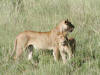
Also while your there you will hopefully get to see the amazing wild life such as the lions and lionesses. Chances are though you will see the lionesses as the lions being the males will be lazing about back with the rest of the lions chilling while the lionesses do all the work!

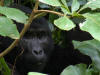
Then if you go to visit Bwindi National park you should get to see Gorillas see above! Its not often that you will be able to see such wildlife roaming around its the chance of a life time!

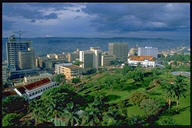
The pearl of Africa is packed with all sorts of stunning place to visit! Apart from the stunning wild life Uganda also has its up and coming capital Kampala which is packed with vibrant people who are so welcoming and has delicious fruits and I saw pineapples the size of errrmmm maybe one and a half footballs which tasted so juicy! See kampala in picture!

I miss Uganda now and want to go back!


The King and the Poor Man

There was a king who decided to take a tour of his country. As he passed by different places, everyone rushed to see him. However, while passing by a certain place, he noticed a poor old man who did not pay any attention to the king's arrival and remained engaged in his own activities. The king went up to this poor man and asked why he did not join the people to see him. The poor man replied, "Before you, there was another king who once passed by this place. Everyone gathered to see him as well. But, few days later he died and was buried in a place nearby. A poor man also died during that time and was buried near the king's grave. After some time, a strong flood passed through that area causing the graves to overturn. The bones of the poor man became mixed up with those of the king's. We could not differentiate between them any longer as to which bones belong to the king and which ones belong to the poor man. After seeing this, it does not matter to me anymore as to who is a king and who is a beggar. In the end, our home is the same.”

To Kill A Mocking Tongue!

Yesterday I was trying to find a picture of a famous footballer I had seen a few weeks ago on the internet. The reason I was looking for it as it was a very funny picture as it was taken at a strange angle while the player was in the middle of a game. My initial plan was to post it with a funny comment. However thankfully I was advised by someone that this may fall under backbiting and at the very least would certainly not be of good character. As a muslim we have been taught on numerous occasions not to make fun of others, not to immitate others, riddicule others, insult or offend others. So part of the character of a Muslim is NOT to make fun or to laugh at and mock others which unfortunately is a terrible disease that has spread through out the Muslim community globally and Im addressing this to myself 1st. Anyways I came across a really nice article by Muhammad Al Shareef which I thought Id share with you. Ive edited it making it slightly shorter as I know how busy you all are prob sneaking on to this blog in a quick tea break from work or in my case while my nephew who I look after is fast asleep in his morning nap!
May Allah guide us all away from mocking others ameen.

note:
sal Allaahu alayhi wa sallam is arabic for- Peace and blessings of Allah be upon him and it is said after the name of the Prophet Muhammad (pbuh)

radi Allahu 'anhu is arabic for- May God be pleased with him and its usually said after the names of one of the companions of the Prophet (peace be upon him)

To Kill A Mocking Tongue!


Al-Ma'roor ibn Suwayd narrates that he once saw Abu Dharr – radi Allaahu ‘anhu – wearing a beautiful shawl. His slave standing next to him was wearing a shawl exactly like it, warm and beautiful.
Ma'roor said to Abu Dharr, “Perhaps you could take the shawl of your servant and give him another (less expensive) one.”
“Never,” said Abu Dharr,
“for I once had a servant whose mother was not Arab and I cussed him and his mother. That servant went to the Messenger of Allah – (sal Allaahu alayhi wa sallam) – complaining of the words I had said.
“When Rasul Allaah – (pbuh)– saw me he commented, ‘O Abu Dharr, you are a man who still has Jahilliyyah (Pre-Islamic Ignorance) in him.'”

Because of these painful words, Abu Dharr – may Allah be pleased with him - would always dress his servants in the exact same garments that he would wear.


Dear brothers and sisters in Islam, family and friends, God is disobeyed most with our tongues. There is a sin that sweeps amongst us, a sin that many take lightly, a sin that is laughed at, a sin that could very well pull someone to Hellfire: It is the sin of insulting others.

Read carefully this following verse. It is a commandment of Allah that begins with a call to those who claim to have Eemaan. Allah ta'ala says in the Qur'an (49/11):
O you who believe let not one group of people make fun of another, perhaps the (one's being made fun of) are better then them. And let not women make fun of other women perhaps the (woman being made fun of) is better then them. And do not insult one another and do not call each other by (offensive) nicknames. Wretched is the name (i.e. mention) of disobedience after (one's) faith. And whoever does not repent – then it is those who are the Dhaalimoon (the wrongdoers). Perhaps the one that is being made fun of is more beloved to Allah.


Subhaan Allah, let us remember this if we ever try to make fun of someone, perhaps Allah loves them and does not love us. Didn't the Mushrikeen make fun of Rasul Allah – sal Allaahu alayhi wa sallam – and we know Allah loved him and not them. Didn't the Munaafiqeen make fun of the Sahaabah – and we know Allah loved the Sahaabah and not them.

Abu Moosa – radi Allaahu ‘anhu – said: I asked Allah's Messenger, ‘Who out of the Muslims is the best?' He replied, “Those whom the other Muslims are safe from his tongue and hands.” – Agreed Upon
The mockingbird, native to the western hemisphere, has a very interesting name. The mockingbird gets its name from its ability to mimic the sounds of other animals. It combines song notes of it's own with sounds from other birds, doing so in almost a mocking way. It is an endangered species, and we hope - in sha Allah – that the mocking it got its name after will become endangered in our communities too.
Al-Hasan Al-Basree – rahimahullaah – said,
“Whoever does not guard the slips of their tongue has not understood their Deen.”

In conclusion, the questions that begs to be asked is:


What is the cure for this disease of the tongue?
There are many different cures but we shall just go over a few to start with insha'Allah.

1: We should know that it is a major sin. In fact, a person may make a single statement – not paying any heed to it – by which he may slip in to Hellfire.

2: We should distance ourselves from those long useless gatherings where nothing is done for hours except laughing and chatting. Of course laughing and spending time with family and friends is beneficial and is good to do in fact the prophet Muhammad (pbuh) would also joke with his companions although there was never a lie even in his joking. The point is not to over do it therefore forgetting to also spend time together discussing benefical points remembering Allah and teaching each other something new. But to remember when ever a gathering is based on insulting others then its better to politely leave if you feel that you are unable to steer the discussion onto something which is pleasing to Allah

3: If you feel yourself that you just have to insult someone, ask Allah to protect you from the Shaytaan and this satanic act. As Allah ta'ala says (7/200): And if an evil suggestion comes to you from Satan, then seek refuge in Allah. Indeed, He is Hearing and Knowing.

4: And of course, if anyone of us should fall into this sin, we should be swift in turning back to Allah in Towbah. Say Astaghfirullaah wa ‘atoobo ilayh, O Allah I ask You to forgive me and I return to You.

Allah ta'ala says in the Qur'an (49/11): And whoever does not repent – then it is those who are the Dhaalimoon (the wrongdoers).

Finally, if there is one thing that you remember from this post let it be this following commandment of Allaah ta'ala, memorize it and teach it to at least one other person:

'O you who believe let not one group of people make fun of another.'

Justice!


For those of you who dont know about the Babar Ahmad case please check out the following website for full details... www.freebabarahmad.com Below is a brief out line of who Babar Ahmad is but the website will update you on all the details of how a family have been robbed of their beloved son, brother, uncle, cousin, friend and husband! Its a real life case of injustice which must come to an end! For those of you who are unable to attend the demo listed at the end please raise your hands and make a prayer for Babar Ahmad and his family!


Who Is Babar Ahmad ?

An introduction to who he is: his background and his personality
Babar Ahmad is a British Citizen who was born in London in 1974. He grew up and went to school in South London, where he had been living until his arrest on 5th August 2004.
Family BackgroundBabar's parents came from Pakistan in the early sixties. His father is now a retired Civil Servant who gave over 20 years of service to the Crown. His mother, a qualified Science teacher, has a Master's degree. Babar has three other siblings. Babar and all his siblings went to good schools and obtained professional degrees. One of his siblings is a qualified medical doctor. The family have always paid their taxes and served the community as law-abiding British citizens.

EducationBabar went to a reputable public school where he obtained outstanding results at both GCSE and A-level. He was popular at school; well liked by teachers and fellow pupils. Like any other British boy, he thoroughly enjoyed all sports, especially football and cricket. His school reports would always highlight that he was helpful, well-behaved and popular. He went to university in London where he obtained a Master's Degree with Honours in Engineering. Since graduating he has held a stable job in Information Technology Support at Imperial College, London.

PersonalityBabar has always respected and followed the law of the land where he has spent his whole life. Where others have cut corners and tried to evade the law, Babar has been quick to remind them. He has never even got a parking ticket. He has a real love of children. His kind and considerate nature endear him to all. No matter how busy he may be he always finds time to speak to and play with his nieces and nephews. Babar has a very caring personality. Whenever a member of the family would be ill, he would stay up to attend to them. His youngest sister recalls that whenever she was unwell, he would sleep on the floor of her bedroom in case she needed anything in the night.

His kind nature is not only limited to people, but to animals too. The family once had a pet cat. Babar looked after the cat like a baby. Once the cat fell sick so in an attempt to cheer it up, Babar went to the local pet shop and spent £20 on toys and treats! Babar would feel upset when he would see anyone in need or distress. Whenever anyone had a problem, no matter how small, he always did his best to help find a solution.

Like the rest of the family he was deeply affected and saddened by the events of 9/11. A relative, who the family have always been close to, was on the 106th floor of the North Tower and lost her life on that tragic day. Babar and his family shared the pain and anguish with her family in their desperate search for news of her well-being. Much of the media continues to promote the ideology of guilty until proven innocent in cases such as Babar's. He is nothing like the evil, cold-hearted terrorist that the media and others have made him out to be. All those who have met, lived and worked with him unanimously agree that he is quite the opposite.


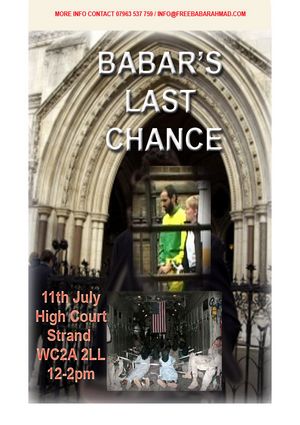
BABAR’S LAST CHANCE

THE HIGH COURT DEMO

Date: TUESDAY 11TH JULY 2006

Time: 12:15 pm- 2pm

Place:
Royal Courts of Justice - the High Court,
Strand,
London WC2A 2LL

Nearest Tube Stations: Temple, Chancery Lane, Charing Cross, Holborn

Babar Ahmad’s appeal against extradition to the United States will begin on Tuesday 11th July 2006.

If he loses this appeal he could be on the plane to America to face gross Human Rights abuses within WEEKS

Join the demo to tell the Government and the world that enough is enough. British citizens will no longer tolerate second-class treatment.

Bring out the evidence in Britain and give Babar a fair trial here, or release him immediately

Confirmed Speakers so far:
Moazzam Begg (Ex-Guantanamo detainee)
Yvonne Ridley (Islam Channel presenter of Agenda programme)
Asim Qureshi (CagePrisoners.com)

Book a day or an afternoon off or even an extended lunch break to attend.

THIS COULD BE OUR LAST CHANCE TO STOP HIS EXTRADITION

NO TO DETENTION WITHOUT CHARGE
NO TO UK-US EXTRADITION TREATY 2003
For further information please email:
info@freebabarahmad.com or telephone 07963537779

www.freebabarahmad.com

Tuesday, July 04, 2006

Ugandan Police!


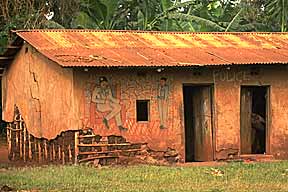
Hmmmm I came across this picture which is apparently a police station in Uganda.... I bet the people feel real safe! Maybe its a sign of how peaceful the people there are... well at least I hope so!

Weekly Country Profile:Uganda


Weekly Country Profile : Uganda

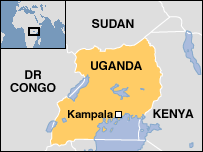
For those of you who dont know my husband was born in Kenya and bought up in Uganda. So I recently visited both places and by the Grace of Allah had the time of my life. Both Kenya and Uganda are such beautiful countries which have so much to offer. The people are very friendly and welcoming with their common phrase everywhere you go 'eeh your welcome' which is always accompanied by a sweet smile its enough to brighten up anyones day! Remember the prophet (pbuh) said smiling is a charity so thats gotta be a good thing.
This week ill try posting facts and pictures within Uganda and perhpas next week will move onto Kenya. Feel free to add any African experiences you guys may have had.
One thing for sure is next time im in that part of the world I hope to climb the famous Mount Kilimanjaro! It looks absolutely breath taking and is a sign of the greatness of The Creator!


Country profile: Uganda

Since the late 1980s Uganda has rebounded from the abyss of civil war and economic catastrophe to become relatively peaceful, stable and prosperous.
But the lives of hundreds of thousands of people in the north remain blighted by one of Africa's most brutal rebellions.
In the 1970s and 1980s Uganda was notorious for its human rights abuses, first during the military dictatorship of Idi Amin from 1971-79 and then after the return to power of Milton Obote, who had been ousted by Amin.
During this time up to half a million people were killed in state-sponsored violence.

Whats happening in London?
Ive heard there is a great exhibition going on in The British Museam on Modern Middle Eastern Art. Its apparently got a beautiful selection of Quranic calligraphy aswell. For those of you who can go its on until September and should be a culture enritching exprience!

Sometimes as Londeners we neglect and miss out on wonderful exhibitions such as this one. London really does have alot to offer and if only we lived the life of a tourist for at least a week im sure we would view London in a compltely different light! Ive lived here all my life and really feel so happy and lucky to have grown up in such a multicultural society which has so much to offer!

Oh yes the best part of this art exhibition...... ITS FREEEEE!


Word into Art:Artists of the Modern Middle East18 May – 3 September 2006Room 35Admission free

Word into Art: Artists of the Modern Middle East is an exhibition based largely on the collections of the British Museum complemented by a number of loans. It demonstrates the imaginative ways in which artists across the Middle East and North Africa are using the power of the written word in their art today.

The exhibition includes wonderful examples of calligraphy transforming writing into art, books of poetry, and works which reflect current issues facing the modern Middle East.

Opening timesDaily 10.00–17.30Open late Thursday & Friday until 20.30
An accompanying book is available from the Museum shops and online at http://www.britishmuseum.co.uk/(£16.99 hardback, £11.99 paperback).